



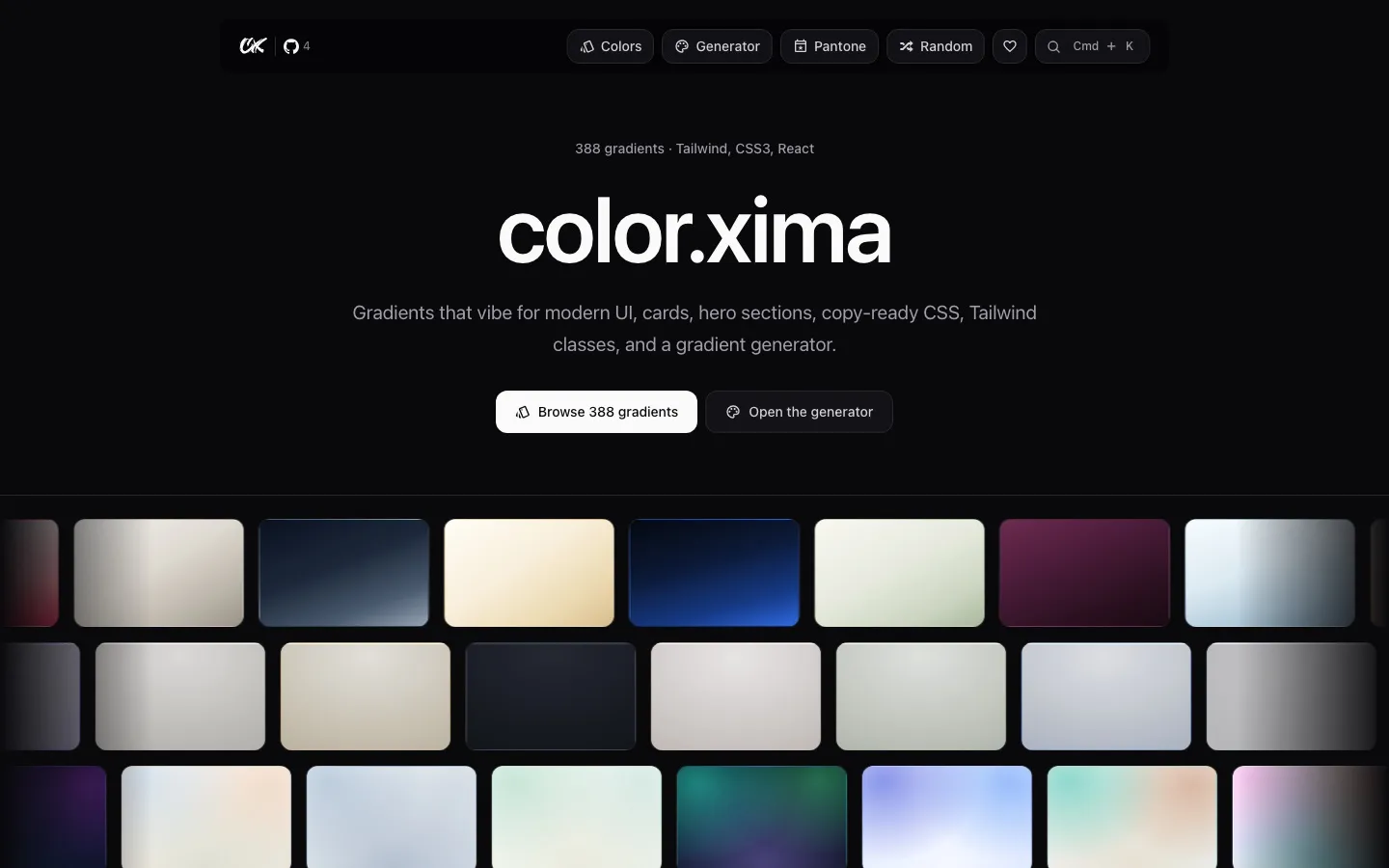
color.xima.work is a gallery of CSS gradients. You arrive with your editor open, find the one you want by eye, copy the code as CSS3 or Tailwind v4, and leave. Sessions are short, and the whole site is built around that.
Inside there are 388 gradients and one architectural decision that everything else follows from.
The catalogue is a stylesheet
A gallery like this normally stores gradients as data: an array of objects with colours, angles and stops, from which the preview and the snippet are assembled by two separate pieces of code. Here it works the other way round.
The source of truth is src/styles/gradients.css, 3,389 lines of real CSS
rules. And src/data/colors.json is a flat index of 388 entries, each carrying
exactly four fields:
{
	"id": "glow-aurora-cyan",
	"name": "glow-aurora-cyan",
	"index": 0,
	"className": "radial-glow-aurora-cyan"
}
No colours, no angles, no stops. Just the class name whose real rule lives in the stylesheet.
From that follows the important part: the preview on the page is rendered by exactly the same rule the copy button hands you. Not “generated from the same data” but literally the same. There is nothing for them to drift apart on.
The snippet is derived from the CSS at build time
At build time, src/data/css-snippets.ts reads gradients.css, finds the rule
by class name and pulls out its body:
const ruleRegex = new RegExp(
	`(^|\\n)\\s*\\.${escapedClass}\\s*\\{([\\s\\S]*?)\\n\\s*\\}`,
	"m",
);
The body is then split into property and value pairs, from which a tidy CSS3 snippet is assembled along with a Tailwind v4 variant. Both are highlighted with Shiki right there at build time, so the browser receives finished HTML with no runtime highlighting.
A regular expression over CSS is usually a bad idea, but here it runs against the
project’s own file with known formatting, not arbitrary input. The cost of a miss
is visible immediately: no rule found means /* style not found */ lands in the
snippet.
The Tailwind converter
The least trivial part is turning ordinary declarations into Tailwind v4
arbitrary utilities. Naively replacing spaces with underscores breaks on the very
first gradient: radial-gradient() contains commas and spaces that must not be
split on.
So the split happens by bracket depth:
function splitTopLevel(value: string, separator: "," | " "): string[] {
	let depth = 0;
	for (const character of value) {
		if (character === "(" || character === "[") depth += 1;
		else if (character === ")" || character === "]") depth -= 1;
		const isSeparator = depth === 0 && /* ... */ false;
	}
}
Border shorthand gets its own handling: 1px solid rgba(...) becomes not a
single [border:...] class but three - border, border-solid and
border-[rgba(...)], the way a person would write it.
A small thing, but small things like this are what keep pasted code from looking machine-made.
Search
Search is Fuse.js in the browser, over an index embedded in the page. Six fields with weights:
| Field | Weight |
|---|---|
name |
0.42 |
description |
0.24 |
tags |
0.16 |
className |
0.1 |
visibleId |
0.05 |
id |
0.03 |
A fuzziness threshold of 0.36 and ignoreLocation: true, so a match counts
anywhere in the string rather than only at the start.
There are two search surfaces and they stay out of each other’s way: a global
overlay on Cmd/Ctrl+K in the header of every page, at most eight results
linking straight to detail pages, and an ordinary field on the catalogue page. On
pages that render the field, the overlay yields the shortcut and stays
click-only.
Descriptions are synthesised
An interesting detail: the gradients have no hand-written descriptions. They are assembled from the name:
export function getDescription(name: string, id: number): string {
	const usage = usages[(id * 3 + 1) % usages.length];
	const type = getTypeLabel(name);
	const palette = getPalette(name);

	return clamp(`${type} with ${palette} palette, optimized ${usage}.`, "for modern UI");
}
The type comes from the name prefix, the palette from the remaining tokens, and
the usage phrase is picked deterministically by id, so one gradient always gets
the same one. The phrase list is finite: hero sections with contrast typography,
product cards, dark dashboards and a few more.
The decision is arguable but honest: nobody is going to write close to four hundred descriptions by hand, and deterministic generation at least keeps the text stable between builds while giving search one more field to match on.
Tags
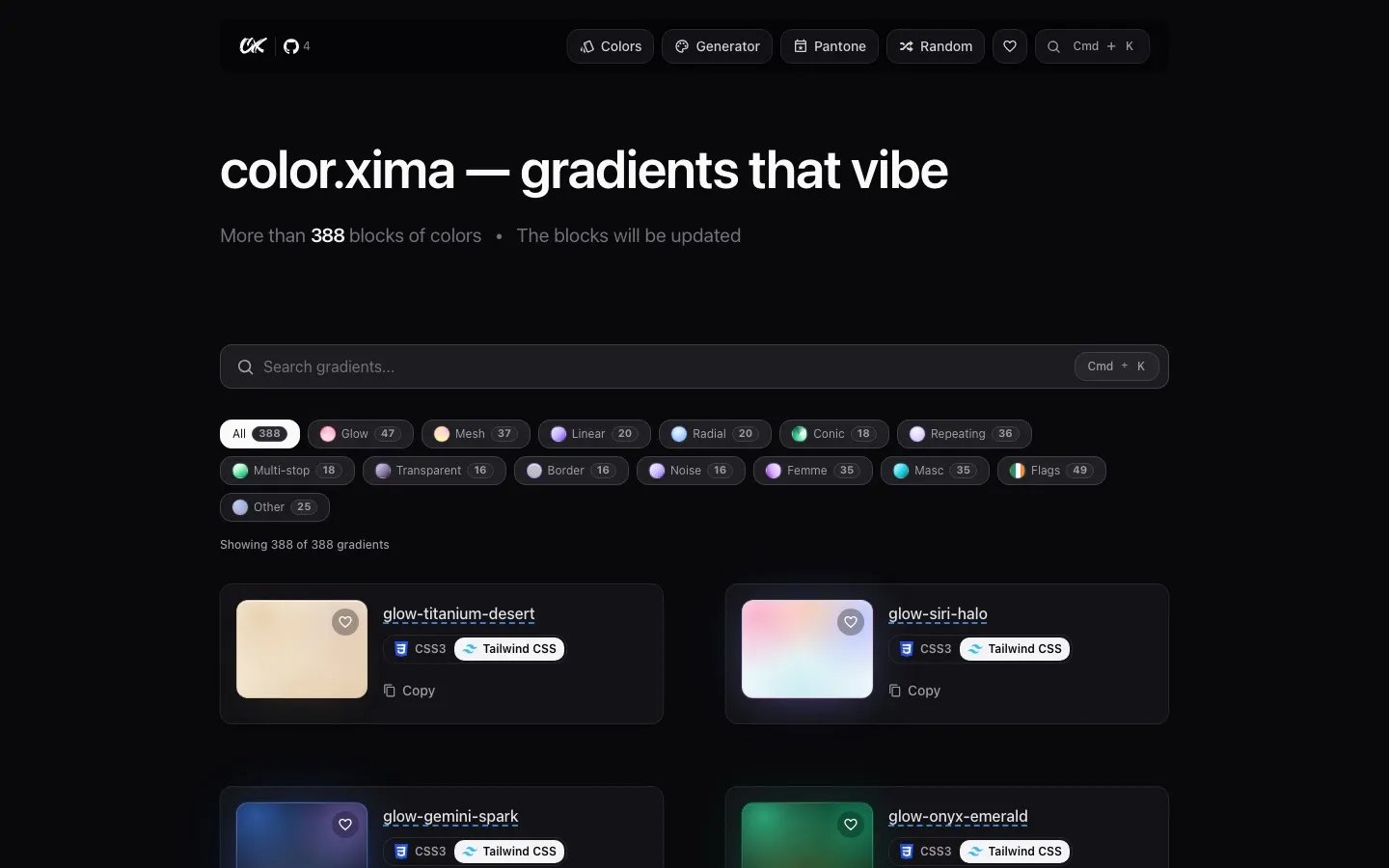
Fourteen tags: glow, mesh, linear, radial, conic, repeating,
multi-stop, transparent, border, noise, femme, masc, flag, other.
They are not assigned by hand but derived from the name prefix:
if (name.startsWith("flag-")) return ["flag"];
if (name.startsWith("mesh-neo-") || name.startsWith("mesh-")) return ["mesh"];
if (name.startsWith("glow-")) return ["glow"];
Naming discipline stands in for metadata. As long as names follow the convention,
tags, filters and collections come for free. The moment a name breaks the
convention, the gradient drops into other - silently.
Pruning the catalogue
A recent pass over the catalogue shows what this architecture buys you. Of 465
entries, 162 were removed, 85 added and 66 renamed, leaving 388. The reasoning
for every change sits next to it in PRUNE.md rather than drowning in a diff:
byte-identical duplicates, near-indistinguishable pairs, gradients whose names
nobody would ever search for.
Because the catalogue is a stylesheet, the prune came down to deleting rules from the CSS and entries from the index. Neither previews nor snippets had to be rebuilt: they are derived from that same file anyway.
Pantone Color of the Year
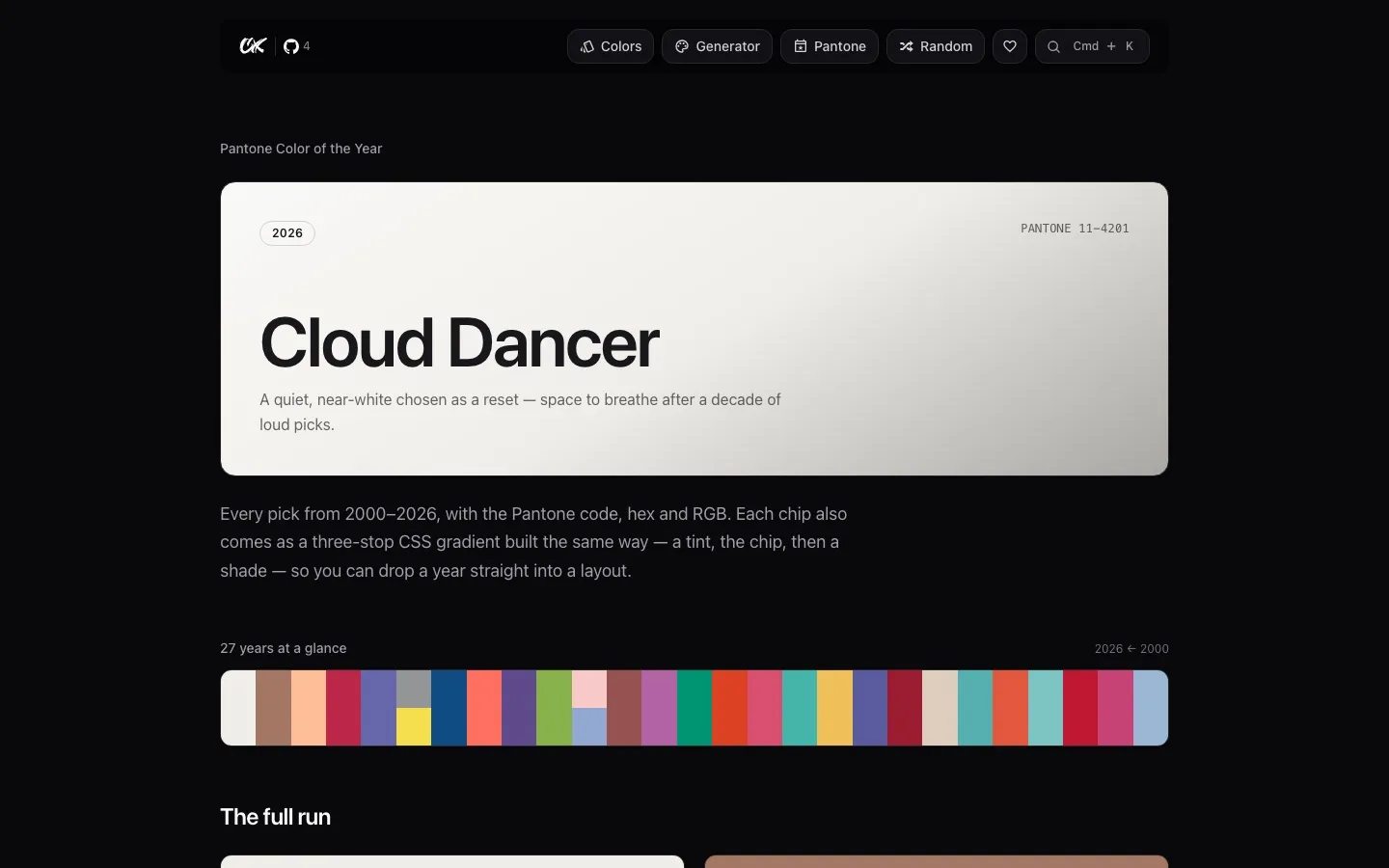
A new section at /pantone/: every Pantone pick since 2000, each with its TCX
code, hex and RGB. Two years shipped a pair rather than a single colour, 2016 and
2021, and they render as a split swatch.
The honesty in the data comment is worth noting: Pantone picks colours for physical inks and textiles, so every hex here is the widely published sRGB approximation of the TCX chip rather than an exact conversion, and two sources can disagree by a point or two.
Each chip also becomes a three-stop CSS gradient - a tint, the chip, then a shade - so a year can be dropped straight into a layout.
Routes
/                     the main gallery
/cards/               every card with copy buttons
/gradient/[slug]/     a single gradient page
/collection/[tag]/    a collection by tag
/generator/           generator: block, text, presets
/generator/mesh/      mesh gradients
/generator/instagram/ an Instagram post
/pantone/             Pantone Color of the Year since 2000
/picks/               curated picks
/daily/               redirect to the gradient of the day
/random/              redirect to a random one
/favorites/           favourites
/daily/ and /random/ are redirects rather than pages: on a static site that
is cheaper than rendering the same thing under several addresses.
Static and deployment
Astro 5 in static mode, Tailwind v4, deployed to Vercel. Caching is one rule in
vercel.json - a week plus stale-while-revalidate on every response.
There is a single static OG image for the whole site, rebuilt with bun run og.
For a gallery that is sensible: drawing an Open Graph preview per gradient is a
lot of work for pages that are rarely shared.
Licences
Two of them, and that is the right call:
- the repository code is MIT;
- the gradients themselves are CC0, public domain. Take them into any project, commercial included, with no attribution.
For a gallery whose product is the snippets, the second licence matters more than the first. Without it there is no telling whether the copied code may be used at all.
What catches the eye
Three notes from the code. Observations, not complaints.
Search matches names, not colour. The index holds no hue and no lightness,
only strings. A query for cyan finds glow-aurora-cyan because the word is in
the name, but there is no way to ask for “something cool and dark”. For a gallery
where the main selection method is your eyes that is a deliberate trade, but the
ceiling of text search is visible here.
wrangler sits in the dependencies while deployment goes to Vercel.
@astrojs/vercel is right next to it and the deploy config is vercel.json. It
looks like a leftover from an earlier attempt to move to Cloudflare.
Tags fall into other silently. Nothing checks that every gradient ends up
with a meaningful tag. One gradient with a non-standard name disappears from
every filter without saying so.