



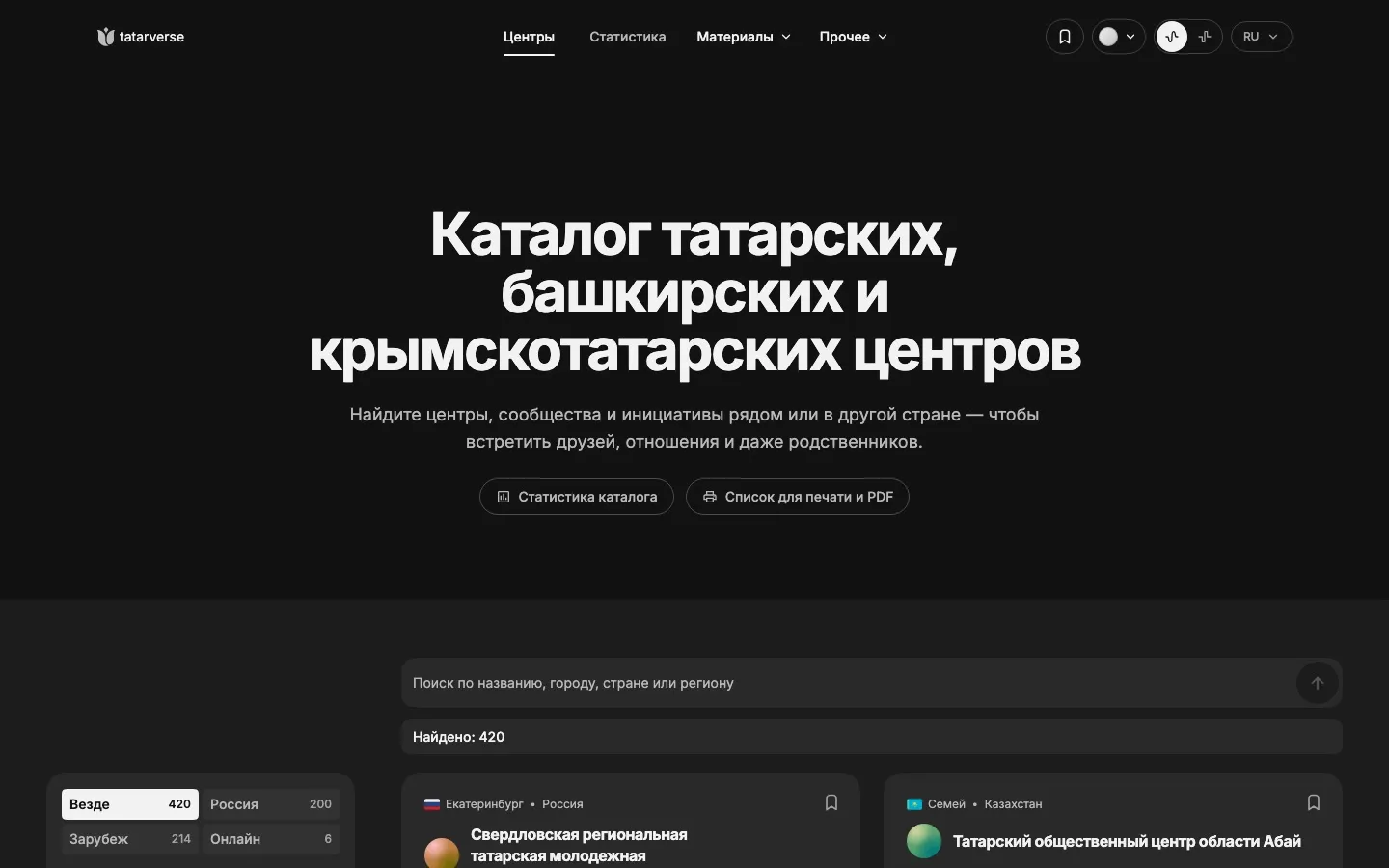
tatarverse.cc is a catalogue of Tatar, Bashkir and Crimean Tatar centres, communities and initiatives: 420 entries across 53 countries. The code is fully open, design system and AI agent instructions included. Here is what it is made of, where the traps were, and where to start if you want to help.

Why static
The catalogue has no accounts, no cart and no feed. It has data that changes
rarely and pages that must be served fast worldwide. No server needed:
output: "static" turns the whole site into HTML files served from a CDN.
A separate decision: no UI frameworks. No React, no Vue, no Svelte, no animation library. Astro components and CSS keyframes only. In numbers that is 54 components and 19 pages, with not a single hydration island.
{
	"astro": "7.0.3",
	"@astrojs/mdx": "7.0.0",
	"tailwindcss": "^4.0.9",
	"fuse.js": "^7.3.0",
	"wrangler": "^4.92.0"
}
On top: @astrojs/sitemap, @astrojs/rss, astro-icon, @dualmark/astro for
markdown twins of pages, and @vite-pwa/astro. Bun as the package manager,
Cloudflare Pages via Wrangler for deployment.
Content: four collections, strict schemas
Not a single database. Everything is files, described in src/content.config.ts:
| Collection | Folder | What is inside |
|---|---|---|
centers |
src/data/centers_formatted |
420 Russian entries |
centersEn |
src/data/centers_i18n/en |
363 English translations |
posts |
src/data/posts |
editorial notes |
thanks |
src/data/thanks |
contributor credits |
Every schema is .strict(). An unknown frontmatter field is not ignored, it
fails the build. That strictness is deliberate: data comes from many different
people, and a silently swallowed typo in a field name is worse than a red build.
Geography is not part of the schema. src/data/geo (ruRegions,
macroRegions, places) normalises location at render time for facets,
search and cards. The country flag is not written into MDX by hand either: it is
derived from the country name through countryFlagsByRu in
src/data/worldCountries.ts.
Entry slugs are stable, shaped like tbk-389. They cannot be changed: links
already circulating in chats and on centre websites depend on them.
The design system: two files that must agree
The design system lives in DESIGN.md, 566 lines of reasoning about why things
are the way they are. Next to it sits the machine sidecar
.impeccable/design.json. The rule is hard: change one, change the other.
Single sources of truth: accents in src/utils/accents.ts, palettes in
src/styles/palettes/*.css, tokens in src/styles/tailwind.css. No literal hex
values and no raw Tailwind palettes in components, semantic tokens only.
The surface ladder
The load-bearing rule of the whole system: muted sits between background and
surface.
dark:   background < muted < surface < surface-muted < subtle
light:  surface > background > surface-muted > muted > subtle
A section band takes bg-muted and is recessed relative to the page; a card on
that band takes bg-surface and is raised above it. Swap the two and the
catalogue collapses.
That is exactly what used to happen. In dark, muted sat above surface,
and at three presets they landed on the same value: orange 20%/20%, pink
15%/15%, red 13%/12%. Several hundred cards rendered in the same colour as the
band behind them. In light, surface and background were both pure white, so
every bg-surface panel was white on white.
Derived tokens
Four tokens are not authored per palette. They are computed from their own backing surface:
| token | formula |
|---|---|
surface-muted |
color-mix(in oklab, surface 94.5%, surface-foreground) |
border-muted |
color-mix(in oklab, surface 86%, surface-foreground) |
border |
color-mix(in oklab, surface 80%, surface-foreground) |
depth-100 |
color-mix(in oklab, surface 84%, surface-foreground) |
The point is not fewer lines. A hand-written border can drift, and did:
border-muted measured 1.10:1 against surface under the red and pink
accents, meaning it was invisible. A derived value cannot fail that way. It is
always a fixed perceptual distance from its own surface.
Meanwhile muted, subtle and the two ink tokens stay authored per palette. A
single global proportion would flatten the presets into each other.
Radius rides the accent
Radius is part of the preset, not a constant. Six presets map onto three shape registers: six different geometries would turn the scale into a set of accidents.
| register | presets | micro | control | card | catalog |
|---|---|---|---|---|---|
| default | green, orange |
8 | 16 | 24 | 32 |
| medium | violet, pink |
8 | 12 | 18 | 24 |
| small | blue, red |
6 | 8 | 12 | 16 |
red joins the small register on purpose: it is the loudest accent in the set,
and the strict shape balances it. The steps compress non-uniformly, because
large radii can give up proportionally more, while a flat multiplier would push
micro down to 4px and make it indistinguishable from a square corner.
The print view of the catalogue (/centers/print) keeps raw radii: paper should
not shift with a screen preset.
Lift
Two utilities instead of hand-written dark:shadow-* pairs:
surface-liftfor things in the flow: cards, feature sections. A soft shadow in light and no shadow at all in dark, where the lightness step already separates the layers.overlay-liftfor things floating over the page: menus, popovers. In dark, a1pxinset highlight along the top edge instead of a shadow from below.
A black shadow on a near-black page draws nothing and still costs compositing.
Surfaces a change must survive
A change is not done until it survives every surface it touches. A single catalogue card lives under all of these at once:
| surface | what to check |
|---|---|
| Accent | 7 presets via [data-accent]: default (monochrome), green, blue, violet, red, orange, pink |
| Theme | light, dark, system, contrast holds in both |
| Motion | [data-motion="off"] and prefers-reduced-motion |
| Locale | ru unprefixed, en under /en/ |
/centers/print with its own layout |
|
| Filters | the toolbar reads data-* straight off the DOM |
“It builds” does not count as a check.
Client scripts
There is not much JS on the site, and all of it is about the interface rather than the data.
centersToolbar.ts is the catalogue engine: search, facets, active filters.
Filter axes are not hardcoded. A group declares itself with data-filter-group
and the set of axes is read from the markup. Previously each group name was
written into the state type, into the query parameter map and into four branches
of the filter logic, so adding a fifth axis meant editing eight places.
Three things the filter hierarchy did not work without:
- Live counts. They used to arrive from the server once, so after picking “Kazakhstan” the number 17 was still hanging next to “Perm Krai”.
- Zero options hide themselves. That also reconciles the levels: pick Ukraine and regions and cities of other countries drop to zero and disappear.
- Sections appear conditionally (
data-filter-gate). City is not shown until a country or region is picked, otherwise it is a list of 122 rows.
savedCenters.ts handles saved cards. There is no server and never will be,
so the list lives in localStorage. It stores not just an id but a snapshot of the
card: /saved renders straight from storage with no request to the catalogue.
The snapshot is read from data attributes the card already carries, so the same
strings are not duplicated in the markup.
appearance.ts handles theme and accent. The first application happens in an
inline script in <head>, before first paint, otherwise you get a flash of the
light theme. Listeners are attached to document, so the number of switches on
the page does not matter.
Project scripts
bun run dev
bun run build
bun run cf:preview     # run the built dist through Cloudflare locally
bun run cf:deploy      # build and publish
bun run release:bump   # version in package.json and src/data/release.json
bun run brand-kit      # a PDF with every preset
release:bump is the only way to change the version; package.json and
src/data/release.json are never edited by hand. A pre-push git hook sits on
top: it checks that the push carries new commits and the tree is clean, bumps the
version, commits, and then aborts the current push so the release commit goes
out with the next one. Forks do not need it: RELEASE_BUMP_SKIP=1 git push.
brand-kit builds one HTML page with all seven presets in both themes and prints
it to PDF through headless Chrome. It duplicates no values: it reads
tailwind.css and palettes/*.css and rewrites the selectors so fourteen states
can coexist on one page. A copy of the palette inside the generator would mean
the brand kit diverges from the site the day someone edits a token.
Markdown twins and Cloudflare
The site is static, so the @dualmark/astro endpoints never reach production:
only the body of the .md file lands on disk. Headers computed per request, and
content negotiation by Accept or User-Agent, cannot be expressed in a static
_headers file.
Hence the Cloudflare Pages function in functions/_middleware.js: it detects AI
bots, negotiates the format and serves the markdown twin instead of HTML. The
logic is deliberately conservative. If a page has no twin, it serves normal HTML
rather than a 404.
The agent layer
The project is openly set up for work with AI agents, and that layer is in git too.
.agents/skills/ holds 13 skills. Eight are the project’s own, prefixed
tatarverse-: astro-content, posts, ui-tailwind, brand, motion,
i18n, page-weight, collab. Five are third-party: impeccable,
design-taste-frontend, high-end-visual-design, redesign-existing-projects,
full-output-enforcement. The third-party ones are pinned in skills-lock.json
and updated with bunx skills add, never by hand-editing SKILL.md.
.claude/skills/ symlinks to the same directories, so Codex and Claude see one
identical set and there is one copy to maintain.
There are three hooks:
posts_style_check.pyruns onPostToolUseand, after every edit undersrc/data/posts, reports style violations with line numbers.- The
impeccablehook checks UI files after an edit and does a deep pass onStop. pre_tool_use_guard.pyandsession_start.pyguard the entry points.
AGENTS.md fixes three hard bans for posts, and a machine checks them rather
than memory: no long dashes, no Cyrillic “e” with two dots, and no spelling of
the brand with a capital V in the middle. The correct form is Tatarverse, and
lowercase tatarverse in the body of a post.
Two more rules from the same file, both paid for in real damage:
Pick up the traces. After deleting a file, an export, a route or a constant,
rg its name across the whole repository, .md docs and skills included.
Deleting the contrast-audit scripts left DESIGN.md pointing at them, and
removing the map left CONTRIBUTING documenting geo fields that no longer
existed.
export * does not bring a name into the re-exporting module’s own scope.
Move a shared constant into a leaf module and the barrel that uses it now needs
an explicit import too. astro check passes. The build is what fails.
Nuances and bugs
The surface ladder inversion and the invisible border are above. Two more.
The motion toggle hangs components. The switch in the header writes
data-motion="off" on <html> and forces animation: none and
transition: none on everything. Any component whose state machine waits on
animationend or transitionend then hangs forever. Such places are carved out
and given animation-duration: 1ms instead of none, because the event still
has to fire. The mobile drawer is the precedent.
The locales diverge, and that is fine. 420 Russian entries against 363
English ones. Routes with no English version are listed in ruOnlyRoutes in
src/i18n/index.ts, together with what the language switcher should do: stay
or move to a hub page.
How to contribute
The most valuable contribution is verified data, and it does not require being a programmer.
Path one, entirely in the browser. No git, no terminal, no Node. Entries live
in src/data/centers_formatted/, one file per centre. On GitHub, open the folder
and press t to search by file name. If you only know the title, search the
repository with path:src/data. Then hit the pencil, Edit this file, edit in
the browser, and use the Preview tab to see the result. GitHub creates the
fork for you.
Path two is a fork and local development: for several centres at once, translations, and interface changes.
Not sure the data is accurate? Open an issue with a link to the source anyway.
The entry schema
Zod, .strict(), so an unknown field fails the build.
| Field | Type | Required |
|---|---|---|
title |
string | yes |
type |
enum | no |
category |
enum | no |
source |
URL | no |
summary |
string | no |
pubDate |
string | no |
location |
object (also .strict()) |
no |
Inside location: country, region, city, flag.
What breaks most often
- The build fails on the schema. An unknown frontmatter field, or a
category/typevalue outside the enum. sourcefails validation. It needs a full URL with a scheme:https://example.com/, notexample.com.- Russian text on an English page. The key exists in
ru.tsbut not inen.ts, so the default-locale fallback kicked in. bun installfails. Bun 1.3+ is required.git pushrejected over a release commit. That is thepre-pushhook, and a fork does not need it:RELEASE_BUMP_SKIP=1 git push.
When adding an interface string: add the key to every active locale, use an
existing namespace (nav.*, list.*, detail.*, copy.*, feedback.*), and
leave no hardcoded text in components.
What to improve
The most useful work right now is not refactoring but data: verified entry updates, English translations (57 entries behind), source references, accessibility fixes and small interface improvements that keep the existing visual language.
The guides are in the repository in two languages: CONTRIBUTING.ru.md and
CONTRIBUTING.en.md.